What the number measures
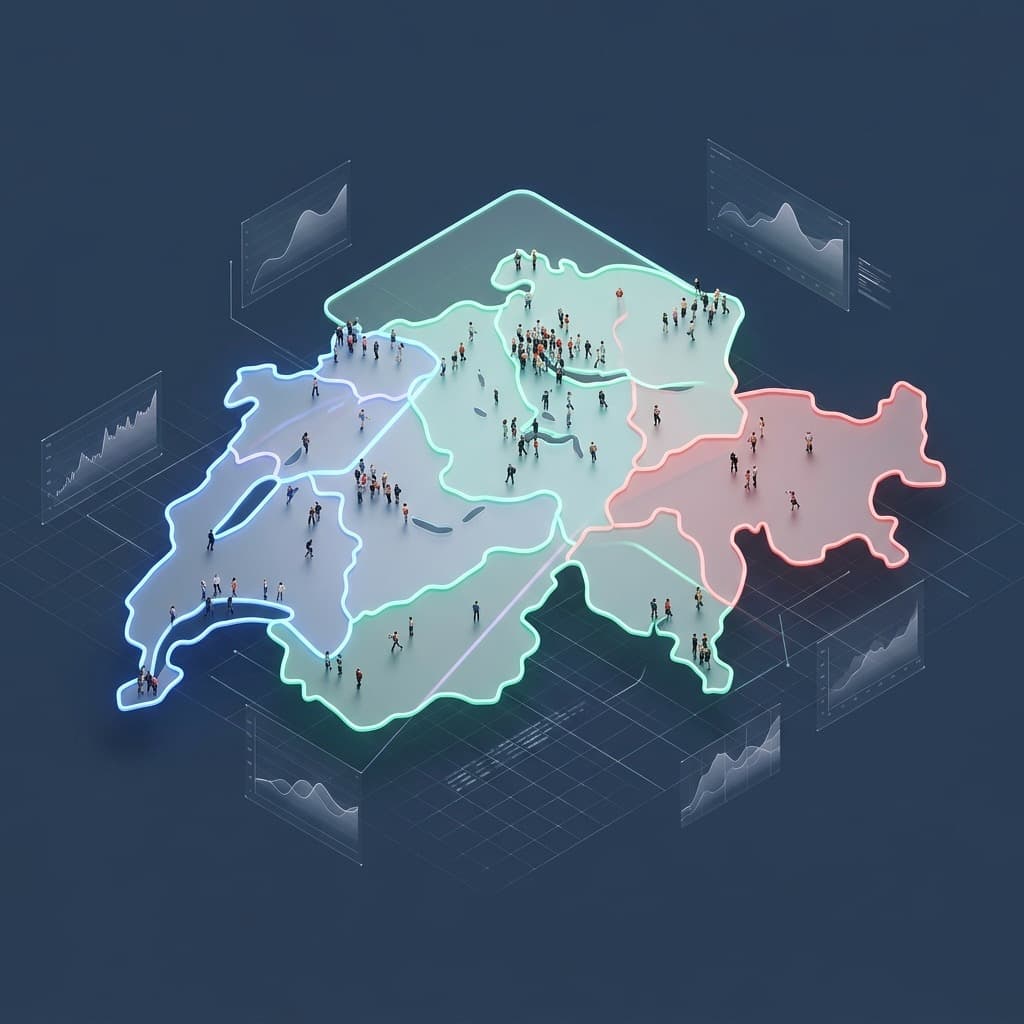
When you look at a mixed postcode, the population figure always covers the entire geographical footprint of that postcode.
Take 1008 Prilly. It shows a population of 14,384. But geographically, that postcode is split almost exactly 50/50 between the municipality of Prilly and the municipality of Jouxtens-Mézery. Those 14,384 people do not all live in Prilly, and they certainly don't all pay taxes there.
By contrast, 1000 Lausanne 25 has 14,299 people, and because its borders fit entirely inside Lausanne, that number maps cleanly to a single municipality.
This is why PLZHub explicitly shows the demographics.isEstimate flag. When that flag is true, the population number is still highly accurate for the postal delivery area, but you cannot treat it as a municipal headcount.

Understanding the geographic weights
The municipalities.weightedSharePct metric tells you how the physical land of a postcode is divided. It does not tell you where the people are standing.
In 1040 Echallens, the land area is split into three roughly equal thirds: Echallens, Villars-le-Terroir, and Saint-Barthélemy (VD). In 1071 Chexbres, the territory is split straight down the middle between Chexbres and Rivaz, with tiny slivers bleeding into Puidoux. In 6110 Wolhusen, the municipality of Wolhusen clearly dominates with 75%, but Werthenstein and several smaller fragments are still trapped inside the same postcode boundary.
Even a seemingly straightforward place like 1033 Cheseaux-sur-Lausanne is mixed: it is 98.4% Cheseaux-sur-Lausanne, but fragments of Crissier and Lausanne are technically caught inside the postal lines.

How to use this data correctly
Read the population figure as a signal for the postcode's density and vibe, not as an official town census.
If you are comparing neighborhoods, looking at transit options, or checking general demographics for a move, the postcode population works perfectly well. But the moment you need to know exactly how many people belong to a specific municipal tax base, you must drop the postcode data and look at the official municipality figures. That is where the postcode's usefulness ends.