What a split postcode actually means
Take a look at 1008 Prilly, 1040 Echallens, or 6052 Hergiswil NW. Each one splits across municipal borders in a different way. That's why you can't just glance at the tax rate or population count—you have to read them alongside the estimate flags.
This isn't a data error. It just means the postal delivery area bleeds into neighboring municipalities. That works fine for delivering a letter, but it's terrible for figuring out your exact tax bill.

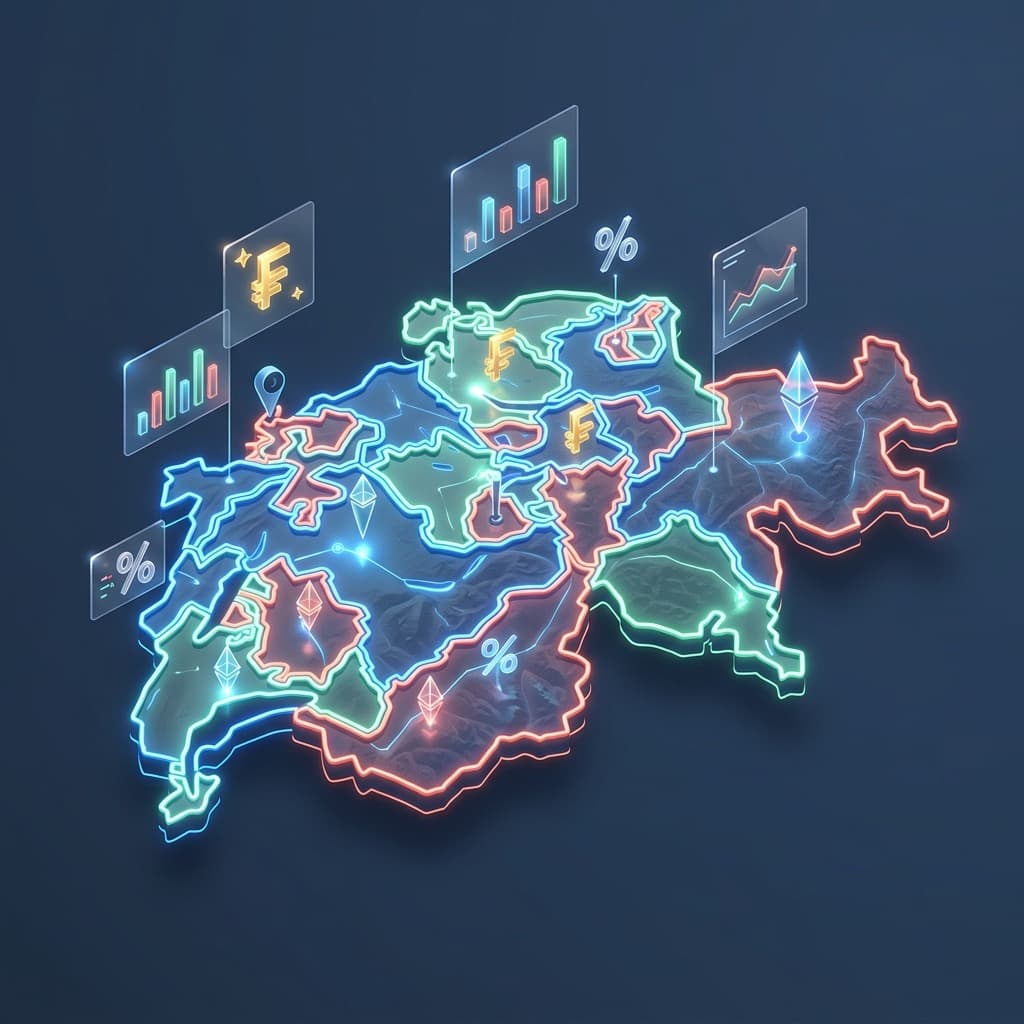
Maps make this obvious. Once you see the borders overlapping, you realize you aren't looking at a single town, but a blended average of several areas.
Taxes belong to the municipality, not the postcode
The tax rate is tied to the municipality, not the four-digit number on your mail. 1008 Prilly is the perfect warning sign: it splits right down the middle between Prilly and Jouxtens-Mézery. So the tax figure you see is a blended average, not a hard fact for everyone living there.

1040 Echallens is similarly messy. It splits almost evenly across three different municipalities. The overall number gives you a sense of whether the area is cheap or expensive, but it won't tell you what you'll actually pay. 6052 Hergiswil NW is much cleaner—99.8% Hergiswil and a tiny 0.2% sliver of Horw. It behaves like a single municipality most of the time, but technically, it's still split.
Population counts get messy too
You have to treat population numbers for split postcodes the same way—as rough estimates for an area, not an exact headcount. 1148 Chavannes-le-Veyron looks like a single town, but it actually bleeds across several borders, meaning its population of 2,438 is an estimate.
1033 Cheseaux-sur-Lausanne proves why even small overlaps matter. It's overwhelmingly Cheseaux-sur-Lausanne, but bits of Crissier and Lausanne slip in. The population figure of 5,063 is an approximation based on that exact mix. Whenever you see demographics.isEstimate set to true, you know you're looking at a blended number.
Estimates are for orientation, not precision
When tax.isEstimate and demographics.isEstimate are true, use the page to get your bearings. It tells you if a postcode area generally leans cheap, expensive, densely populated, or rural. Just don't mistake it for a single administrative district.
If you want a clean reading, look at something like 3011 Bern, which sits neatly inside one municipality. Split postcodes are the opposite. The data is still incredibly useful, but you have to understand the mix before you trust the numbers.